The government plans to expand both large-scale and specialized “small-but-strong” data centers based on advanced Graphics Processing Units (GPUs) and domestic Artificial Intelligence (AI) semiconductors. As the country accelerates AI Transformation (AX) in sectors where South Korea holds global strengths, such as manufacturing, it will also strengthen its “AI Full Stack” export strategy, which comprehensively bundles national AI capabilities.
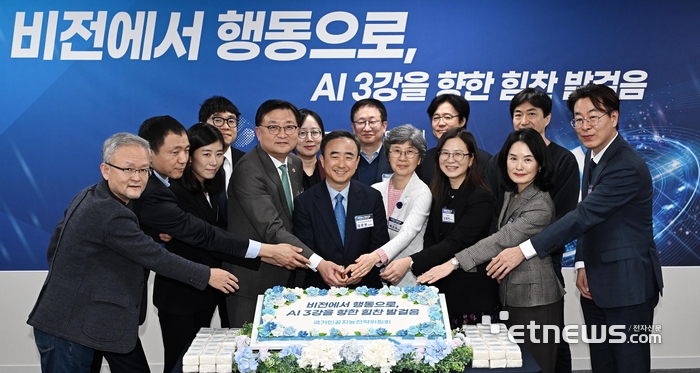
On the 15th, the National AI Strategy Committee unveiled the “AI Action Plan” (formerly AI Action Plan), which contains 98 tasks detailing these objectives. Aiming to leap forward as one of the world’s top 3 AI powerhouses, the committee presented implementation tasks for each ministry, centered on 3 key policy pillars and 12 strategic fields: △Creating an AI Innovation Ecosystem, △Pan-national AI-based Transformation, and △Contribution to a Global AI Basic Society.
The government will establish AI and data governance to support the era of Great AI Transformation. By expanding infrastructure, including domestic AI-specific data centers, the government aims to complete the computing, data, and security framework necessary to build an “AI Highway,” allowing AI services to be used anywhere in the country.
To preempt next-generation AI technologies in fields where Korea has strengths, such as manufacturing, the government has set a goal to achieve “No. 1 in Physical AI by 2030.” It plans to secure core technologies and data while establishing a virtuous cycle where AI accelerates scientific discoveries.
Furthermore, the plan includes establishing a continuous education system spanning elementary, middle, and high schools, and interconnecting and streamlining AI talent development programs currently divided among various ministries. This aims to build a foundation for fostering AI professionals and to promote the inflow of overseas AI experts into Korea.
Laws and institutions will be refined so that original personal information and copyrighted works required for AI learning can be used safely and freely without rights infringement or legal uncertainty. The government also plans to combine AI with cultural content to achieve the status of a cultural powerhouse. In the defense sector, it will operate hubs in five locations nationwide, including Pangyo and Yangjae, where defense data can be safely utilized, and push for the realization of an AI-based defense powerhouse through the construction of Defense AI Data Centers.
The government will establish an implementation plan for an “AI Basic Society” covering labor, welfare, education, and healthcare. It also foreshadowed the global spread of this “AI Basic Society” model, led by the “APEC AI Initiative” confirmed in Gyeongju last November.
The plan also includes newly identified tasks beyond existing national policy tasks. Representative examples include shifting the security paradigm to a preventive focus—such as introducing a preemptive and constant security inspection system utilizing private “white hackers”—and redesigning public systems using private sector capabilities while establishing professional governance.
The committee will conduct public consultation on the AI Action Plan via its website for 20 days starting from the 16th. Opinions will also be gathered from industry, academia, research institutes, civil society, and relevant organizations. Through this process, the AI Action Plan will be continuously supplemented and finalized at the 2nd plenary meeting early next year. It is scheduled to be reported to President Lee Jae-myung in its final form.
Lim Moon-young, Vice Chairperson of the National AI Strategy Committee, stated, “The public consultation on the AI Action Plan is conducted with the premise of making revisions,” adding, “We will reflect any rational opinions or suggestions that do not hinder the realization of the grand goal of a National Great AI Transformation.”
Reporter Park Jong-jin | truth@etnews.com